
Last updated: October 2026
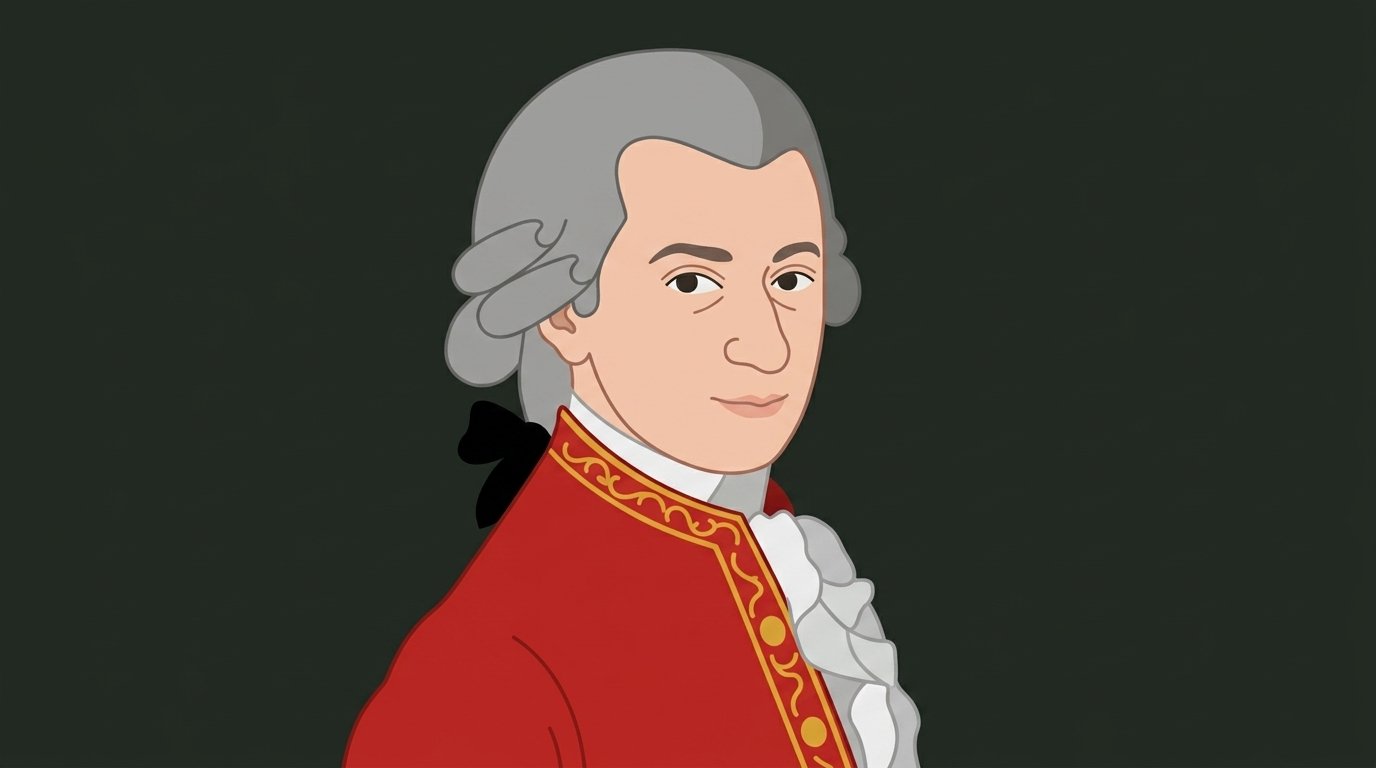
Wolfgang Amadeus Mozart was one of the most gifted composers in the history of Western music, and in 2026 the world is celebrating him again. He was a prolific and influential composer of the Classical period, born on 27 January 1756 and dead before he turned 36. He wrote operas, symphonies, concertos and church music, and much of it is still played every day. This guide explains Mozart’s life story in simple terms, covers his music, clears up some famous myths, and shows what is happening for his 270th birthday year.
Mozart: Quick Facts
| Detail | Information |
|---|---|
| Full name | Wolfgang Amadeus Mozart |
| Born | January 27, 1756, Salzburg (today in Austria) |
| Died | December 5, 1791, Vienna, aged 35 |
| Profession | Composer, pianist, violinist, organist |
| Parents | Leopold Mozart and Anna Maria (née Pertl) |
| Sister | Maria Anna “Nannerl” Mozart |
| Spouse | Constanze Weber (married 1782) |
| Famous works | The Marriage of Figaro, Don Giovanni, The Magic Flute, Requiem |
| Total works | More than 600 |
Mozart’s Life Story: A Child Prodigy in Salzburg
Mozart was born at Getreidegasse 9 in Salzburg and was the youngest of seven children, five of whom died in infancy. His older sister Nannerl survived and became a skilled keyboard player herself. His father Leopold was a musician and was also the boy’s main teacher. The baptism record gives a long name, and as an adult Mozart usually called himself “Wolfgang Amadè.” The form “Amadeus” is the Latin version of the Greek “Theophilus,” and both mean “loved by God.”
Little Wolfgang learned fast. One source says he began composing around age five, and a Spanish biography adds that his father found his first pieces in Nannerl’s notebook, written in a child’s handwriting with ink blots. The family made several long journeys across Europe in which he and Nannerl performed as child prodigies. These trips taught him a great deal, but they were also tiring for a small child. One music-history source notes that the constant travel did not leave him unharmed.
Teen Years and Travels in Italy
When Mozart was a teenager, his father took him to Italy. In Bologna he was accepted as a member of the famous Accademia Filarmonica, and in Milan he wrote the opera Mitridate, re di Ponto in 1770, which was a success. A popular story says he heard a secret church piece by Allegri once and wrote it out from memory, and a Portuguese biography says the pope honored him with a gold decoration. These stories are famous, but they come from general biographies, so treat the small details with some care.
Life at home was less happy. After his mother died in 1778 while the two were in Paris, he returned to Salzburg and took a job as court organist. He did not stay long. While visiting Vienna in 1781, he was dismissed from his Salzburg position. That moment pushed him toward a risky choice: working as an independent composer.
Mozart’s Career in Vienna
In Vienna, Mozart tried to earn a living without a steady court job. In 1782 he married Constanze Weber, after being turned down by her older sister Aloysia. His early years in the city went well, and one source says he earned a relatively large income for the time. However, neither he nor his wife knew how to handle money, and later years were harder. This is one reason his life story is often told as a tale of talent and money trouble.
His greatest operas come from this period. The Marriage of Figaro appeared in 1786, Don Giovanni in 1787, and The Magic Flute in 1791. He left more than 600 works across almost every form of his time. Because he never numbered his pieces himself, a later scholar named Köchel put them in order, which is why you see “K.” numbers like “K. 550” on Mozart recordings.
The Last Year and Mozart’s Death
His final year was very busy. His output in 1791 included the opera The Magic Flute (premiered September 30), the Clarinet Concerto (October), and work on the Requiem. He also became ill in Prague during the premiere of La clemenza di Tito on September 6, 1791. He died shortly after midnight on December 5, 1791, less than two months short of his 36th birthday.
What caused his death is still debated. The official record named a fever illness called “hitziges Frieselfieber,” yet modern doctors have offered many theories, and one medical review notes that a death certificate has not been found. The Requiem was left unfinished, and it was completed by Franz Xaver Süssmayr after being commissioned in secret by Count Franz von Walsegg. His widow Constanze later worked to give the finished piece as much Mozart authority as possible.
Mozart Myths: Salieri and the “Pauper’s Grave”
The most famous myth says that rival composer Antonio Salieri poisoned Mozart. The earliest recorded hint that his death was not natural appeared in a Berlin news weekly less than a month later, and the story was made far more popular by Peter Shaffer’s 1979 play Amadeus. Historians say there is almost no reliable evidence for it. Salieri did claim late in life that he had poisoned Mozart, but that claim came while he was in poor mental health, so it is not treated as proof.
Another myth says Mozart was thrown into a mass grave. One classical music magazine says he was buried in a simple unmarked grave that was normal for Vienna’s middle class, not a communal pit, and that his wife and his patron Gottfried van Swieten bought his coffin. His exact grave spot is not known today. The truth is less dramatic than the legend, which may be why the legend lasts.
Mozart in 2026: The 270th Anniversary
This year people are celebrating Mozart’s 270th birthday. The 2026 Mozart Week festival marked two anniversaries: the 270th birthday of Mozart and 70 years since the festival began in 1956. It ran in Salzburg from January 22 to February 1, 2026. At its center was a new production of The Magic Flute, directed by Rolando Villazón. Salzburg is also marking the anniversary with concerts, exhibitions and cultural events throughout the year.
The celebrations reach beyond Austria. In October 2026, pianist Yunchan Lim gave a recital in Daegu, South Korea, for the anniversary, ahead of a planned complete cycle of Mozart’s piano sonatas at Carnegie Hall in New York and Wigmore Hall in London. We could not confirm exact dates for those later concerts, so check each venue for current schedules.
How This Was Researched
I researched this biography using reference profiles, opera house and music-history pages, articles on the Salieri and burial myths, medical-history reviews, and 2026 news about the anniversary. I compared the main dates, such as his birth, marriage and death, across more than one source, and I marked the points where sources disagree, including his cause of death. I avoided one low-quality page that contained clear errors. Many biography pages repeat the same timeline, so this article tries to add a clear myth-versus-fact section and the 2026 anniversary news.
Accuracy Note
This biography is based on publicly available information, including reference works, musical institutions, and verified news coverage. Some details about Mozart’s life and death are uncertain or debated, and we noted that where it applies. If you spot anything outdated or incorrect, please let us know so we can update it.
Written and researched by Usama Khan, contributor at lopin magazine.
FAQ
Who was Mozart?
Wolfgang Amadeus Mozart was an Austrian composer of the Classical period, born in Salzburg in 1756 and known for operas, symphonies, concertos and church music.
When and how did Mozart die?
He died in Vienna on December 5, 1791, aged 35. The exact cause is still debated, and the official record named a fever illness.
Did Salieri poison Mozart?
There is almost no reliable evidence for it. The idea became popular through a 1979 play and a later film, but historians treat it as a myth.
What is Mozart best known for?
He is best known for operas like The Marriage of Figaro, Don Giovanni and The Magic Flute, and for his Requiem.
How many works did Mozart write?
He wrote more than 600 works. They are listed with “K.” numbers from a catalogue made after his death.
What is happening for Mozart in 2026?
It is the 270th anniversary of his birth, marked by Salzburg’s Mozart Week and events around the world.

Usama Khan is the founder and editor-in-chief of Lopin Magazine, where he oversees the site’s biography and news coverage with a focus on accuracy and well-researched storytelling.