
Last updated: 2026
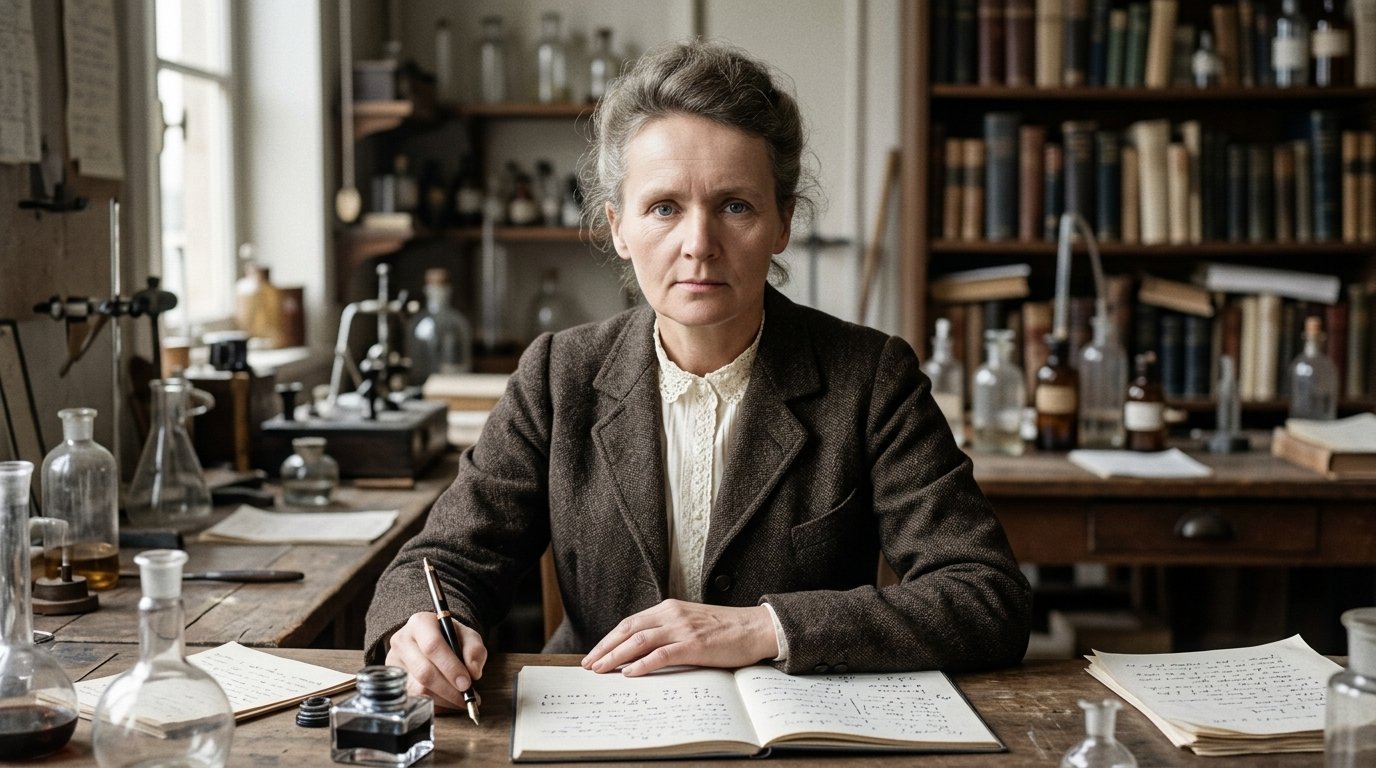
Marie Curie was a Polish-born, naturalised French physicist and chemist who changed how the world understands radioactivity. She was the first woman to win a Nobel Prize and, even today, she is the only person to win Nobel Prizes in two different sciences. This Marie Curie life story is easy to mix up with other things that use her name, because a large UK end-of-life charity and a big European research funding programme are both named after her. This article is only about the scientist, who lived from 1867 to 1934. Below you will find her background, her discoveries, her family, how she died, and a 2026 update that many older profiles do not have.
Marie Curie at a Glance
Before the longer story, here is a quick summary of the basic facts. Most of these details come from the Nobel Prize website, museum pages and reference sources, and where sources differ, this article says so.
| Detail | Information |
|---|---|
| Birth name | Maria Salomea Skłodowska |
| Born | 7 November 1867, Warsaw (then under Russian rule) |
| Died | 4 July 1934, Haute-Savoie, France, aged 66 |
| Cause of death | Aplastic anaemia, linked to long exposure to radiation |
| Profession | Physicist and chemist |
| Education | University of Paris (the Sorbonne): physics degree 1893, maths degree 1894 |
| Husband | Pierre Curie (married 1895; he died in 1906) |
| Children | Two daughters: Irène Joliot-Curie and Ève Curie |
| Famous for | Radioactivity research, discovery of polonium and radium |
| Nobel Prizes | Physics 1903 (shared) and Chemistry 1911 |
Early Life and Education
Maria was born in Warsaw to a family of teachers, and her father taught in a secondary school. At that time Poland was under Russian rule, and women were not allowed to study at university there. She took part in a secret, underground Polish education system, often called the Flying University, and she worked as a governess for about three years so that her older sister could finish medical school in Paris.
In 1891 she moved to Paris and enrolled at the Sorbonne, where she changed her first name to Marie. She studied hard, often with very little money, and she finished first in her class in physics in 1893. A degree in mathematics followed in 1894. I found stories about family losses in her childhood on some student pages, but I did not find them in the main sources I checked, so I have left them out instead of repeating them.
How Marie Curie Met Pierre Curie
In 1894 she met Pierre Curie, a physics professor who was already well known for his research. They shared a love of science, and they married in 1895. Their partnership became one of the most famous in the history of science, since they worked side by side in a small, poorly equipped laboratory. Later they had two daughters, Irène and Ève.
Marie Curie’s Discoveries: Radioactivity, Polonium and Radium
In 1896 the physicist Henri Becquerel found that uranium gave off strange rays, and this inspired Marie to make the topic her doctoral research. She tested other materials and found that thorium was also radioactive. She then studied pitchblende, a uranium-rich ore, and noticed it was more radioactive than its uranium content could explain, which meant something new was hiding inside it. She is also credited with coining the word “radioactivity.”
By the end of 1898 the Curies announced two new elements. They named one polonium, after Marie’s home country of Poland, and the other radium. Over the next years Marie worked to separate pure radium from large amounts of ore, a slow and heavy job, and she measured its properties carefully. One museum page I found gives 1888 as the date of the radium discovery, but the Nobel Prize site and other sources give 1898, which is the date I used.
Marie Curie Nobel Prizes
Marie Curie won two Nobel Prizes, and no other woman has won in two different sciences. The table below shows both, based on the Nobel Prize website and museum records.
| Year | Prize | What it was for |
|---|---|---|
| 1903 | Physics (shared with Pierre Curie and Henri Becquerel) | Research on radioactivity |
| 1911 | Chemistry (awarded to Marie alone) | Discovery of polonium and radium, and the isolation of pure radium |
The 1903 prize made her the first woman to receive any Nobel Prize. In the same year she earned her doctorate, which sources describe as the first one awarded to a woman in France. The 1911 prize came during a very hard time, because the press attacked her over her friendship with the physicist Paul Langevin. She was also turned down for membership of the French Academy of Sciences that year, and a month after receiving the Nobel she was hospitalised with depression and kidney trouble.
After Pierre’s Death: Sorbonne Professor and the War Years
On 19 April 1906 Pierre Curie was killed in a road accident in Paris when he was struck by a horse-drawn wagon. Marie was 38 and left to raise two young daughters alone. The Sorbonne asked her to take over his teaching post, and on 5 November 1906 she became the first woman professor at the Sorbonne and in France. She also attended the first Solvay Conference in 1911, where she was the only woman among leading physicists such as Einstein, Planck and Rutherford.
During the First World War she turned her knowledge to saving lives. She helped equip around twenty vehicles with X-ray machines, which were nicknamed “little Curies,” so doctors could find bullets and broken bones close to the front line. She also trained nurses and helpers to use the equipment, and her daughter Irène worked beside her. This war work is often missing from short biographies, yet it shows how she tried to use science to help people directly.
Institutes and Her Daughters
Marie directed the Curie Laboratory at the Radium Institute in Paris, which was founded in 1914. She later helped found the Curie Institute in Paris in 1920 and the Curie Institute in Warsaw in 1932, and both are still major medical research centers today. Her elder daughter, Irène Joliot-Curie, went on to win the Nobel Prize in Chemistry in 1935. Her younger daughter, Ève, became a writer and published a well-known biography of her mother called Madame Curie. In that sense, the family story is also a science story that continued for another generation.
How Did Marie Curie Die?
Marie Curie died on 4 July 1934 in Haute-Savoie, France, at the age of 66. Her illness was aplastic anaemia, a serious blood condition, which is linked to her many years of working with radioactive materials. In her time, the dangers of radiation were not well understood. The Nobel Prize biography notes only that she died after a short illness, and a few sources give slightly different place names for the exact spot, so I used the wider region.
Marie Curie in 2026: The Eiffel Tower List
Most pages that rank for her name stop with her death, but there is real news in 2026. On 26 January 2026 the Mayor of Paris, Anne Hidalgo, unveiled a list of 72 women scientists proposed for inscription on the Eiffel Tower. Since 1889 the tower has carried the names of 72 French scientists, all men, and the new list would add 72 women just above them. Marie Curie is on the list, along with her daughter Irène Joliot-Curie. In the reports I found, the names still needed final approval from three French academies, and one report said the inscription could come as early as next year, so I have not described it as finished.
Awards and Legacy
Beyond her two Nobel Prizes, Marie Curie is remembered through the element curium, which was named in honor of Marie and Pierre. In 1995 her remains were moved to the Panthéon in Paris beside those of Pierre, which made her the first woman buried there for her own achievements. Her name is also used in the Marie Skłodowska-Curie Actions, an EU research fellowship programme that marks its 30th anniversary in 2026. Many people still use her story as an example of what hard work, curiosity and courage can do.
How This Was Researched
I researched this biography using the Nobel Prize website, museum and university exhibitions, science museum records, news coverage of the 2026 Eiffel Tower announcement, and reference pages. I cross-checked the main dates, such as her prizes, Pierre’s death and her own death, across at least two sources and noted where they disagreed, like the date given for radium. Search results for this name are crowded with a UK charity, a school and an EU programme, so I focused on separating the scientist from them and on adding her 2026 news. I do not know anyone connected with Marie Curie, and nothing here comes from private contact.
Accuracy Note
This biography is based on publicly available information, including the Nobel Prize website, museum records and published news coverage. Some details, such as the exact place of her death and the status of the Eiffel Tower inscription, are reported differently or may change. If you spot anything outdated or incorrect, please let us know so we can update it.
Written and researched by Usama Khan, contributor at lopin magazine.
Frequently Asked Questions
Who was Marie Curie?
Marie Curie was a Polish-born, naturalised French physicist and chemist who researched radioactivity and, with Pierre Curie, announced polonium and radium in 1898. She won Nobel Prizes in 1903 and 1911.
How many Nobel Prizes did Marie Curie win?
She won two, in Physics in 1903 and in Chemistry in 1911. She remains the only person to win Nobel Prizes in two different sciences.
Who was Marie Curie’s husband?
Her husband was the physicist Pierre Curie. They married in 1895, and he died in a road accident in 1906.
How did Marie Curie die?
She died on 4 July 1934 at age 66 of aplastic anaemia, which is linked to long exposure to radiation.
What did Marie Curie do in World War I?
She helped equip around twenty mobile X-ray vehicles, called “little Curies,” and trained helpers to use them near the front lines.
Is Marie Curie the same as the Marie Curie charity?
No. The UK charity named Marie Curie, founded in 1948, supports people at the end of life and uses her name, but it is a different organization.
Is Marie Curie going to be on the Eiffel Tower?
She is on a list of 72 women scientists unveiled in January 2026 for inscription on the tower, but the list still needed formal approval in the reports I found.

Usama Khan is the founder and editor-in-chief of Lopin Magazine, where he oversees the site’s biography and news coverage with a focus on accuracy and well-researched storytelling.